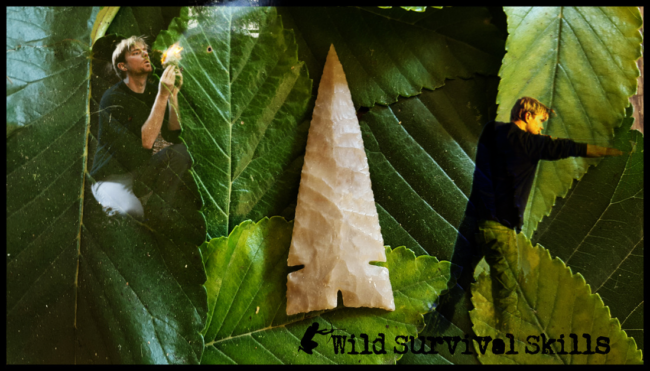
 Over twenty years ago I met a young instructor at the world-renowned Tracker School, run by Tom Brown Jr. He was teaching bow and arrow making, among other skills. I was blown away by his attention to detail and craftsmanship. In a subsequent course, the "scout class," all students, myself included, made "scout pits" which were hidden, subterranean sleeping shelters that we slept in during the week-long course. This young instructor was also teaching at that class, however, I learned that he had taken the subterranean sleeping shelter to another level. At the time, he was living in an underground hogan shelter that he built, complete with a fire chimney that exited secretly through an old hollow stump on the surface.
That young instructor was Tom McElroy. Since that time in the Pine Barrens of New Jersey, Tom has ventured around the globe, from the Amazon to Australia, to New Guinea, to remote tropical islands and beyond. Each of his explorations is fueled by a curiosity to learn from nature and to share this information with others.
Today we interview Tom to get a teaser-sampler of the wisdom behind some of his experiences. Tom has taught everyone, ranging from children to hunters, to outdoor enthusiasts, and even elite military groups such as Seal Team Six. He has consulted for numerous news programs, Hollywood movies, and was featured on the Discovery Channel. He holds a BA degree in Anthropology and Geography from Rutgers University and a Masters in International Policy related to Indigenous Peoples from the University of Connecticut. At the age of 18, he spent an entire year living completely off the land. During that time, he built and lived in a shelter made from the land, made fire by friction, purified water naturally, hunted, fished and gathered all of his own food.
Tom takes wilderness living skills to the level of a true artist. You can see this for yourself in the detail of his handmade tools. His tools are not only functional, but beautiful. This is evident in the pictures of his handicraft included in the interview below. Pathways Dojo has been fortunate to have Tom guest instruct at some of our events.
Here's Sensei to tell you a little about his connection with Tom...
 Tom and I actually live in the same town of Santa Cruz, California. I first heard of Tom through local friends. I met him when we did a podcast interview of him at his house several years ago. We discussed how survival skills and ninjutsu go together. Little did I know that I would be going to one of his island survival courses a few years later. More on that adventure in an upcoming post. That first experience with Tom would lead me to some really fun adventures in nature. I'm really excited that we get to work with Tom. He's an amazing survival skills instructor and is very tuned in to the natural world.
*******
Here's our recent interview with Tom...
Pathways: You have traveled all over the world to learn and teach survival skills. Is there one place/experience that stands out that was extremely challenging? What did you do to overcome that challenge?
Tom: I really believe that the only way that someone can easily survive off the land is if they have a deep knowledge of place, meaning they have an intimate knowledge of the terrain, edible and medicinal plants, animal behavior, weather patterns, density of wood, strongest fibers for rope...etc. While indigenous people are the only masters of survival, you still couldn't take an Inuit person and drop them in the Amazon and expect that they would thrive. Some skills might transfer, but it would still be a struggle to adapt and relearn what you need from the foreign landscape. It's always a challenge entering an unfamiliar place to attempt to survive. The second I walk into a survival situation I have to try to soak up a lot about what is useful to me in that area--playing catch up with what I should already know.
I would say, one of the biggest challenges would be in the Amazon jungle where everything is out to get you. There are spikes on half the trees, mosquitoes spreading malaria, poisonous spiders, and snakes lurking under every fallen log. These are things I can’t plan for, and sometimes it's just luck that has kept me safe from total catastrophe
Pathways: What was the biggest hazard you have encountered?
Tom: I have to admit, with all the chances I have taken, I've been pretty lucky. I try to stay very safe in survival and am hyper-vigilant of anything that can hurt me. In my first full-survival situation I remember breaking firewood and cutting my finger fairly deep when I broke a stick in half. I still have a scar from that. Every time I see it, I think about how the smallest mistakes in survival can lead to big consequences. In Papua new Guinea I saw how tiny cuts would get infected and turn black in a day. That is probably the most common issue that people overlook. Infection is not as much a part of our modern world, but in survival, it's one of the biggest threats to your life.
 Another experience stands out. While staying with a tribe in the Amazon, a hunter named Nanto and I wandered too far into an "undiscovered" tribe's territory in the jungle. They are a very hostile group. Many intruders into their territory have been found dead with a spear in them. One day, we were out blow-gunning birds and came upon Puma tracks on a tree. Nanto mentioned that the shaman had told him that he needed to be wary of Puma as they were a sign that he was in danger. Soon after that, we came across two spears crossed in an 'X' across the trail. Essentially this was our one warning that this one tribe, the Taegeri, were watching and they were telling us that we had gone too far. If we went any further, that would have been the end. Nanto was pretty shaken up when he saw that, which made me literally shake. Luckily we took the warning, turned around, and quickly headed back to his village.
Pathways: Is there a favorite/memorable shelter experience that you have had?
 Tom: One of my favorite shelters I have ever lived in was one that was a completely underground hogan. To get into the shelter you would lift a small oak bush to reveal a door, then climb down a ladder into the shelter. One could walk directly over it and not know it was there. I even had a “chimney” going into a hollow tree stump to dissipate the smoke so you wouldn't notice it.
Pathways: What's one of the tastiest wild meals that you have eaten?
Tom: In my island survival class we get pretty into creating amazing meals while in a full-survival situation. We caught spiny lobster and crab and made coconut cream bisque with Mango dessert. After 4 days in survival, that may be the best thing I have ever tasted.
Pathways: Do you have a memorable/favorite fire-making experience?
 Tom: After 25 years since making my first friction fire, I still get a huge kick out of it. When I lived in the woods at age 18 for a year, I wouldn't allow myself to have any fire unless I got it with a hand drill or bow-drill. After consistently getting friction fire for 6 months, one day it just stopped working. I still don’t understand why, but I could not get a friction fire for about 5 days. This was in the middle of December, so you can imagine how difficult it was to not have light or warmth in my shelter, warm food and all the things I was taking for granted. After 5 days, to finally get that back was incredible. I was so grateful then and still feel grateful even today when I get a fire.
Pathways: What about a memorable water gathering or landscape/water experience?
Tom: One time I drank from what I thought was a clean spring when running with the Tarahumara tribe in Copper Canyon in Mexico. It kicked in after my trip, but I felt like my insides were on fire for a few days.
Pathways: Do you have a memorable tracking experience?
Tom: I once was called in to track a tiger that escaped from a pen in New Jersey. It was wandering around the woods and people’s backyards. After tracking cats with prints the size of quarters, it was incredible to track one with prints the size of dinner plates.
Pathways: When you are preparing to go to a new place to enter into a survival living mode, do you have a routine for preparation, such as researching maps, local indigenous practices, hazards, or practicing techniques at home before you go?
 Tom: I try to pour myself into every book of that area to learn about plant life. Then I try to see what indigenous people of that area do/did. I think through all the potential problems I could face and try to play it all out in my head beforehand. Of course there are always surprises, and I only find a few of the hundreds of plants I have studied. But, I do plan for how to provide the basics of Shelter, Water, Fire, Food. After that, I just try to get creative based on what I discover in real-time.
Pathways: Shelter, water, fire, food...every landscape/ecosystem is different. Still, are there common themes to your approach to these needs that pertain to most/all landscapes you encounter?
Tom: One thing I try to emphasize with my classes is that it's the principles of survival that are the most important to learn. For example, when trying to stay warm, in a deciduous forest you would use the principle of insulation with light, fluffy material, like piled leaves, to trap dead air space around your body. I then ask my students, using the same principles, how would you create insulation if trapped in your car in a blizzard. By wrapping yourself in the car seat foam, you can also trap dead air space around your body and stay warm. Totally different situation, different “shelter”, but the same principles.
Pathways: You write that you came to the realization that "experiencing survival-living changes the way people approach their entire lives." How have you seen this in others and in yourself?
 Tom: I feel really fortunate to have spent a year living off the land when I was 18. That entire year I spent about $300-$400 in total. What this has gifted me is the ability to know that no matter what happens in my life, I can always go back to that forest and do that again. Because of this, I felt free to take chances on pursuing my passions rather than always playing it safe. I always had an answer to the big “what if things fall apart?” question. I think this gives people confidence to live in less fear, even if they never actually use it. Knowing you can survive off the land gives you a confidence that even the wealthiest person does not have.
Pathways: If someone is new to survival skills, or lives in an urban area, what is a good way to begin practicing the skills?
Tom: Nature is everywhere. The amount of interesting wild edible plants found in abandoned lots could keep you busy studying for years. I grew up near a lot of woods, but still spent most of my initial learning stages making friction fires in my basement, or setting box-traps for pets. While it's good to get into the forest so that you're comfortable with it, it’s very possible to practice a lot of these skills at home.
Pathways: Why would learning survival skills benefit someone who studies the art of the ninjutsu?
 Tom: In one of my classes, there was a Master Chief from the Navy Seals. He was built like a Greek God and probably one of the scariest people I could ever meet. He had been in the Seals for more than 20 years, and I can't imagine the talents he possessed. During one class on tanning deer hides, my co-instructor had everyone make small leather bags of the buckskin. She taught everyone how to sew various stitches and at some point this Navy Seal called me over asking me how to do a ‘whip-stitch’. I told him that for a guy as tough as he was, I found it funny he was asking me how to sew a tiny little leather pouch to go around his neck. Surely this was beneath him at this point. He then looked at me and commented that being a warrior was about collecting as many skills as possible, and the only way he rose to the top of the Seal program was because he never stopped learning, and finding new things to learn.
*********
To learn more about Tom and to attend one of his upcoming courses, you can checkout his website which also has a treasure trove of tutorial videos. Tom travels the globe teaching and has upcoming courses in the near future that we highly recommend.
As Tom mentioned above, fire by friction is a skill that is a lifelong learning journey. It always has something to teach. Making a bow drill fire kit is a great way to enter this learning journey. Check out the free video tutorial access on our website for making a bow drill fire kit.
But, once you make a bow drill kit, you are only halfway there. There are a lot of small details that are very important to consider when using a bow drill kit. If you know some of these tips, your chances of a successful fire are much greater. This could save your life one day.
In the video below, we go through the next step...some helpful tips for using your bow drill kit that will help you be successful in making fire.


 Before long, a small covey of California quail appeared. Quail are usually very skittish. When they see people they usually run or fly away while making a lot of alarm calls. When these quail came out, one of them flew up to a nearby tree about six feet off the ground. It looked over toward the other bush where the previous little bird was, and then it looked back at us. The quail gave no alarm. The rest of the quail walked by us while continuing to eat. Soon they were right next to us, less than two feet away!
 In today's post, Dai Shihan Mark Roemke shares a technique for locking in the energy of a place of power.
 My daughter learned this technique in the NTTV Live class with Sensei Roemke the other day. The next day we were out with our Ninjas in Nature Youth Program making rope ladders and then practicing the art of disappearing into the the trees. My daughter was the first to climb into the tree. She disappeared high into the tree. Several other young ninjas followed up the ladder and scrambled around the lower branches of the tree. I noticed my daughter was being very still.
 I want to share a short story that just happened to me on my back porch as I was watching the sunrise, drinking my morning mate, and tuning into the language of the birds.


 I noticed too on the ground in the yard below our porch, there were no birds feeding. During baseline, birds are relaxed. Feeding on the ground casually is an example of birds behaving in baseline. Usually our yard would have sparrows, juncos, robins, and cardinals hopping about on the ground searching for breakfast.
 But then my yard became quiet again. This time, however, it had a different feel to it.
 Over thirty years ago, one of Jon's first students was a young guy named Dan Gardoqui. Today Dan is one of the preeminent trackers, naturalists, and mentors of nature connection in North America. He co-founded and was Executive Director for the White Pines Program in Maine. He lives in Maine today where he runs
  goal is to get closer to a moose in the fall, I am going to go to a place on the landscape where I am most likely to find them. So I have to understand what moose are eating, what they are thinking, what they are doing biologically that time of year which is their rut. Or after their rut when they are done breeding, I need to know if they are likely to be alone, or in pairs, or in bachelor groups. If they are in their thicker winter fur and it's a warmer day, they are going to be seeking out cooler and moister areas, so I'm going to have to think about microhabitats. I'm going to have to think about the cool pockets on the landscape. Ecological awareness flows with the rhythms of nature and is about understanding the natural history of animals and how habitats are preferential or not to different animals.
 Dan: This one is fun. "Helper" is a bit biased. It implies that the animals have the intention of being helpful to humans, and they may actually. I'm not sure we can say they definitely do or definitely don't. Some of the most well known examples are of ravens. There are many stories about these birds and how they sometimes act as guides to help people or other animals find certain things on a landscape, such as carcasses or prey species. If you pay attention to some basics of how ravens communicate, and if you are open to the fact that you are in communication with them, because frankly we all are in communication with the animals in one way or another whether we are conscious of it or not, then they can truly help you with some of your goals. The flip side of this relationship is that the ravens also get a benefit. For instance, if you are a hunter, and the ravens are helping you find your prey, after you successfully get that animal, you may leave parts of that animal behind after you process it. Then, the ravens will benefit from this food. There are other examples of this such as the honey guides in Africa.
 to humans as well. Knowing our human behaviors and patterns is really helpful and wise when we want to stay safe and alert. But, also start to pay attention to everything else. It can be pigeons, crows, rats, squirrels, little sparrows. Start to give your attention to things that are not human and be open to a fact that they are speaking a language that we can understand. Just start being curious, ask questions, and develop relationships with them. The more you spend time in the same place, quietly listening and observing and being open, chances are those individuals are going to get used to you being there. When you give them your attention and respect, they are probably going to do the same for you. Start by just listening, watching, and giving them space. Say you are walking down a sidewalk, and there's a pigeon in front of you feeding on the sidewalk, just slow down and go around it. If you start to give birds a little more space and respect, it changes the dynamics, and it changes the way you see the world.
 Dan: This is what I was just talking about. Doing the quiet sits and giving birds your attention and respect for example. Doing this just helps us get out of our own little bubble of thoughts, emotions, and things that might cause disturbance around us. If you think of yourself as moving through a pond, when the mind is quiet, the ripples you cause and the way you move is much smoother, so there are many less ripples or disturbances. When the mind is busy, we tend to cause quite a wake, ahead and behind us. This tends to push things away from us. Many species are very sensitive to our thoughts and emotions, and where we are in our heads, including our own species. It's easy to tell if your family or friends are in a tough space or not. So it's silly to think that wildlife can't detect this as well. Whatever helps you to get to this calm mental space, be it yoga, breathing exercises, or meditation, it's going to help you be more "invisible" in the forest. But it's not really being invisible to me because that means we are trying to hide from something. To me it's more about having integrity with the vibe of a forest or nature. It's not thinking that our human existence is the most important thing. It's just being open to all the other things that exist around us.
 places before you decide the techniques you are going to use to blend in with that place. For instance, the pace that you would move in a busy city street in rush hour in order to blend in better be pretty quick. Whereas the pace you are going to use in a quieter rural wild area will probably be a bit slower. So getting to know the baseline of a place and how to blend in with that baseline and how to be invisible, that's part of the stealth and camouflage. So you really need to know a place. Camouflage is not just about colors and patterns. It's about our energy and speed, our body movements, and where we put our eyes. There's all sorts of little tricks in there.

 To take a deeper dive into the art of bird language, we recently connected with Jon, a renowned author, tracker, naturalist, and mentor. Jon is a guiding force in bringing the practice of deep nature connection to the planet and is a pioneering voice in teaching the ancient art of bird language through his workshops and book,
  JY: An example of bird language happened here on the evening of March 16. As the sun was going down. There were some deer feeding in the yard peacefully. There were three adult male deer and two yearling males. The yearlings were being yearlings. They were playing with each other. They were going off a little bit too far from from their uncles who would coax them back to the herd. The five bucks were feeding peacefully out in the meadow. At one point, a young male wandered off into the forest, on the east side of the field. Then on the west side of the field, where there is a forest edge, something changed. Out of that forest edge came the alarm call of the spotted towhee slowly moving from south to north following something unseen on the ground.
 JY: Bird language really helps our brains. Also it opens up our awareness of the three dimensional space and has deep neurological benefits that brings us to the quiet mind. In the quiet mind, we’re able to hold silence and not be stressed out by the anxious thoughts that run through our head. Awareness of bird language allows us to be present in the moment. Of course, it allows us to see a lot more when we are moving around.
