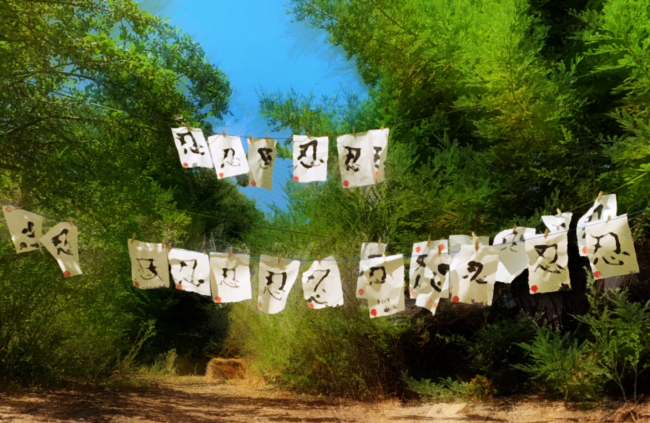
The Spirit Behind Calligraphy
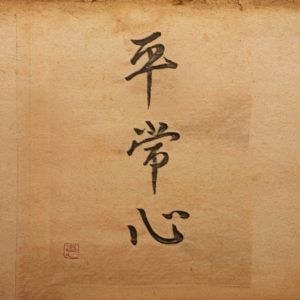 In our last blog, Dai Shihan Mark Roemke discussed his perspective on observing the Grandmaster of ninjutsu, Hatsumi Sensei, create calligraphy during his classes in Japan as gifts to his students. We wanted to seek out someone with an inside perspective on the art of Japanese calligraphy who also understands the practice of ninjutsu. Megumi Whittle is one of those unique individuals.
Born and raised in Osaka, Japan, Megumi came to the United States to study English literature and poetry. After learning the rhythms and rhymes of English poetry, she rediscovered her roots in Japanese language and culture.
Since 2002, she has been studying Japanese calligraphy and ink painting under Horino Seisen in Atlanta, Georgia. She is a certified calligraphy instructor and a member of Shihan Kai under Horino Shodo School in Tokyo, Japan, and has achieved the level of Sandan.
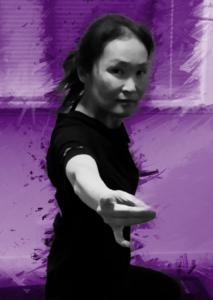 Megumi Whittle describes herself with one word— passion. Her personal mission is to "...share the joy that empowers us to become better selves."
Her method for this?
Being a teacher and student.
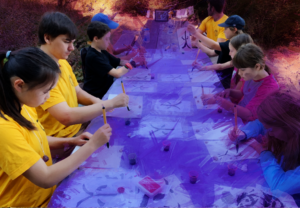
She teaches classes that include Japanese language, cultural immersion, calligraphy, and origami. She is the first Japanese female to be certified under the Gracie Jiu-Jitsu Instructor Certification Program. She is also currently an advanced student of Bujinkan ninjutsu with Pathways Dojo. Pathways Dojo is fortunate to have Megumi Sensei as a Japanese cultural arts and calligraphy instructor. We recently found a window in her busy teaching and learning schedule to ask her about the value of calligraphy to the modern martial artist.
Pathways: Why did you decide to study calligraphy?
Megumi: All Japanese students learn calligraphy in schools. I also took after school calligraphy classes growing up during my elementary school years. After I left Japan to study in the United States, I started to look back at my heritage. Calligraphy came to my mind as one of the Japanese cultural arts to study. I met my master in Atlanta and started learning as her pupil in 2002.
Pathways: How do you view the relationship between martial arts and calligraphy?
 Megumi: I think that both are essential— they go side by side, and they are parts of a whole. There is an idiom called 文武両道 (Bunbu Ryōdō). Hatsumi Sensei mentions this in one of his books. He says, “...to follow both roads of scholarship and war. Do not become too absorbed by only one of them.” This idiom is widely used in many schools and dojos as a motto to commit to both scholarship and sports/martial arts. Also, it is used as a phrase that means to be good at both literature and sports. Historically, both 文 and 武 were the expected expertise for leaders. 文 may include calligraphy, arts, tea, poems etc. Having both qualities were equally valued.
Pathways: How has becoming a teacher of martial arts and calligraphy influenced your personal training in these arts?
Megumi: To teach comes with great responsibilities. I strive to be dedicated and passionate about learning what I am teaching.
Pathways: Do you have a favorite calligraphy that pertains to ninjutsu?
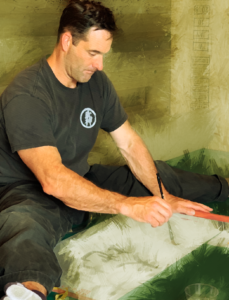 Megumi: Many come to my mind. If I have to choose one, it would be 心 技 体.
This phrase is widely used by many artists and martial artists. In his book, Hatsumi Sensei says, “I am teaching shin-gi-tai-ichi— the bringing together of the spirit (shin), technique (gi), and body (tai) into one (ichi)." Having the right heart, the right techniques, and the right body is what we are trying to attain in our journey. We should be responsible for making them healthy and sharpened at all times. That’s why there is no end to our learning— we are always evolving and moving forward. The heart/spirit is the first one mentioned because it’s the most important. It reminds us that we should always ask ourselves if our heart is in the right place.
Pathways: What is one of your favorite teachings of calligraphy and ninjitsu?
Megumi: What I’ve come to find out from my teachers and masters in calligraphy, jiu-jitsu, and ninjutsu is that it all comes down to one teaching: to grow as a human being and be a better version of ourselves.
Masters of each art that I have studied taught me that calligraphy is life; jiu-jitsu is life; ninjitsu is life.
We study these arts not only to advance in our techniques but to recognize, extract and absorb the principles of the arts and apply them to our everyday life. With these principles in different art forms, I hope I am contributing to make a positive impact.
Pathways: How does calligraphy influence your martial arts and vice versa?
Megumi: The more I study both arts, the more I see the similarities and connections. They compliment each other and help me view things from different perspectives. I love learning about classical literature, history, and nature. Ninjutsu and calligraphy both emphasize these areas. I am having so much fun learning both of these disciplines.
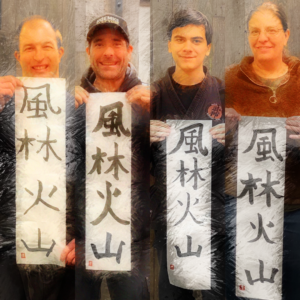 Pathways: For someone new to the art of calligraphy, what do you recommend for a starting point for training in this art?
Megumi: A great way to begin is to practice lines. You can use any writing materials you have such as pencils, pens, fountain pens, brush, fingers, etc... Practice drawing straight lines (vertical and horizontal) and spinning lines, paying attention to the breathing, spacing, pressure, and movement. This is one of the important basic conditioning exercises calligraphers do.
Pathways: Anything else we should know about calligraphy or something you would like to share with us?
Megumi: I really appreciate this opportunity to take a moment and think about things I enjoy and care about. I value the joy of sharing my passions with the Pathways Dojo community. I look forward to meeting your readers in the future online or in person to “play!” as Hatsumi Sensei would say.
If you would like to learn more about Megumi, and how to participate in classes that she teaches, you can visit her website, blog, Facebook or Instagram page.
*********
Check out the calligraphy lesson from Megumi below where she teaches the technique to write the kanji "shin" which means heart/spirit as she describes above.
 By Dai Shihan Mark Roemke
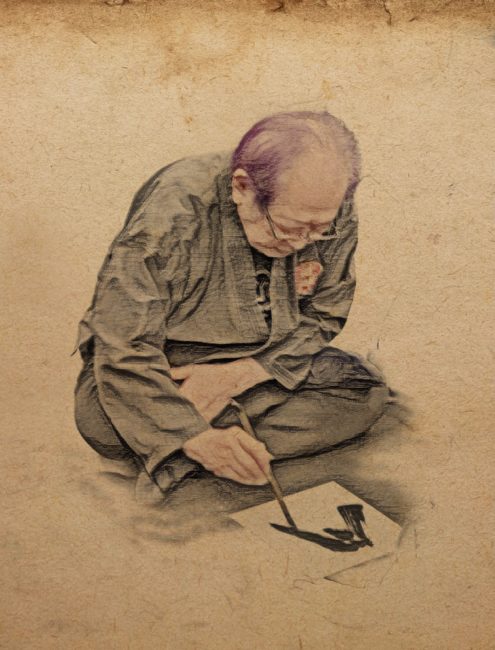
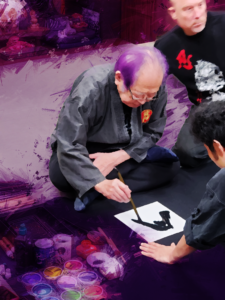 For those who haven't been to the hombu dojo (headquarters) in Nodashi, Japan, whenever Hatsumi teaches, about half way through the class, he will take a break. When this happens, students form a big line in the dojo, each holding a blank scroll or piece of blank calligraphy paper. An instructor then brings out paints, brushes and ink. Hatsumi Sensei will then do individual calligraphy or paintings for everyone waiting in line. Even better, he usually takes requests for his art.
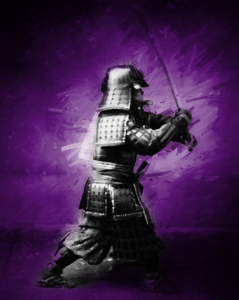 There are so many amazing things about watching Soke wield a brush as the Grandmaster, as a martial artist, and as an artist. His art is an extension of who he is. His books and the walls of the Hombu dojo are filled with his paintings. His art also hangs on the walls of my home and in every one of my dojos.