
Asking for fire
What are the essentials for "survival?" In our recent posts we covered shelter and water. Now for one of our favorites...fire. Here's one of my favorite fire skill memories...
I'll never forget one of the most intense hours of my life.
“One hour to start the fire. The clock starts in three, two, one...go!” the instructor yelled to the 120 students.
Our group had ten students. Immediately, a frantic energy rippled across the landscape. The challenge for each group was to make a fire using only materials from the surrounding forest within one hour. I felt the jittery nerves pulsing through my group, as the crowd quickly dispersed in random directions.
“Wait, I have some intel that will help us!” I called to our group, just as they began to scatter to the forest.
Everyone had ample forewarning of this challenge, a year to be precise. In the prerequisite workshop at the Tracker School the previous summer, we learned how to make fire by friction with a bow drill kit. I remember being the very last person to leave the camp at the end of the week. Most students had succeeded in making their fires by the end of the workshop. As hard as I tried all week with my kit, I couldn’t get it to produce a coal. As my spindle loudly screeched on my fire board as I struggled one last time to get a coal, I could hear the other participant cars driving away.
“Ken, time to pack it up. Gotta go.” The instructor stood over me, looked at his watch, then turned and walked away.
“Just one more try, please,” I begged.
 In a billow of smoke, spindle squeals, and frustration, I quit. I was exhausted. I had burned eight holes already through my fire board, to no avail. I had busted blisters, bloody scraped knuckles, and rope burns. I was exhausted. I gave up. The instructor was right, time to go. As the cloud of smoke dissipated, I noticed something. There was a faint wisp that continued to drift quietly up from my tiny ash pile in the notch of my fire board! I blew gently on this. A red glow appeared from deep within the dark brown ashes. My first coal! I put it into my tinder bundle that had patiently awaited a coal for days. I gave a few blows and it erupted in flame. When this happened during the training week, people cheered and gave high fives. I was all alone in my celebration. I just sat down and smiled as I watched the small bundle burn down to ashes.
Fast forward one year. I was living in Hawaii and preparing to return for the next class of survival skills training— the “advanced camp”. I had heard rumors about the “one-hour fire challenge” that happened at this next training. My friend, Tonnie, a fellow biologist I worked with on the island, attended this same training the year prior. Like most groups who had been given this one-hour challenge, her group had failed to get a fire within the time limit.
 “Tonnie, got any tips?” I asked her. After the previous class of failing, or rather flailing to get a coal, I wanted an edge up on this next fire challenge. I had spent the entire year since my initial class, exploring the types of wood available in an island forest and practiced my bow drill skills intently every few days.
“Yes!” she immediately answered. “Ask for fire!”
“What?!” I didn't understand.
“Ask for fire. Ask the forest to provide what you need. Invite the fire to come to your group. Envision the warmth before you even make the fire,” she said.
“How do we do that?” I asked.
“I don’t know. Whatever works for you or the people in your group. You'll figure it out,” she said.
**********
As our group paused in the center of the growing frenzy of the one-hour challenge, they slowly approached me.
“I have a really good tip for this one-hour fire challenge,” I explained. “We need to ask for fire.”
As our circle of ten came in close, I explained to them what Tonnie had told me. We collectively took a deep inhale and exhale, and sank into a quiet space as a group. Around us, the rest of the class madly scampered in all directions, diving into bushes, climbing trees, running away down trails. It appeared as if we were wasting valuable time. As the clock ticked away, we stood in silence. Then, one by one, we each asked for fire in our own unique way, either silently, or out loud. We envisioned the feeling of the warmth and glow of our tiny, yet to be seen flame.
As we finished our request, I had a flash of a stone in my mind’s eye.
“I’ll go for a stone to cut the fire board notch,” I said.
“I’ll go for the cordage,” someone else replied.
“We will go for the spindle,” another pair answered.
“Tinder bundle, we are on it!” a husband and wife said with raised hands.
“I'll go for the bow,” another said.
“We’ll get the handhold,” the last pair said.
 A stone. Which directions should I go for a stone? I slowly turned a circle. As I rotated to the East, I felt pulled in this direction. I was a marathon runner at the time. I had jogged on the trails out from camp every morning. I was excited about this. I wanted to run. I took off immediately down the sandy trail heading out of camp.
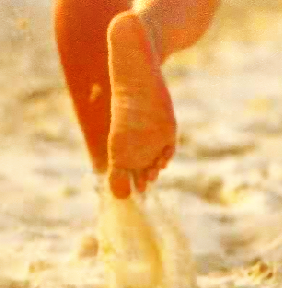
I had learned a different kind of running at this camp. It was a silent form of running. Instead of launching your body with each step, crashing down on your heels with each pump of your legs, this was a gentle movement. In this technique, your feet lead, and you land on the ball of your feet. It’s an ancient form of running based on barefoot running. It was also a form of running where your head didn’t bounce up and down, but instead stayed level as you looked toward the horizon. Twenty years later, when I met Dai Shihan Mark Roemke, I learned a similar technique, called silent ninja running.
At the course, we also learned to use peripheral or “wide angle vision” in order to expand our visual awareness. We also learned techniques for quieting the chatter of our mind in order to sink into a place of mental stillness and awareness in nature.
I layered all of these techniques as I sank into a quiet jogging rhythm. My mind and body dissolved into a moving meditation. I don’t know how far or long I traveled. I wasn’t wearing a watch. I knew, however, that at one point I snapped out of my quiet mind, realizing that I was a long distance from the camp. Precious time was running out. Still, I had found no stone. This landscape was mostly a sandy terrain, remnants from an ancient ocean that had once covered the area. Thus, everywhere I looked, I only saw sand, or an occasional sandstone, which was too brittle for cutting wood. I panicked. Was I going to fail? Maybe I should just run back. I was on the verge of giving up when I passed a small side trail.
 The sensation I experienced when I passed this trail reminded me of water skiing as a youth and being whipped around a corner as the boat turned and tugged on my rope. This little side trail tugged at me. Go this way, was the sensation, so I made a quick right turn. And there it was! A beautiful wedge shaped metamorphic stone in the middle of the trail. I grabbed it, and shifted into high gear for a sprint back to camp.
“Five minutes left!” bellowed the instructor as I entered the large clearing of the main camp. The scene was much different upon my return. Groups huddled all around the forest clearing, with some students darting back and forth in desperate searches for materials. My group was in the center of it all, looking dejected. They had given up.
As I approached them I noticed that they had a perfect tinder bundle made of an abandoned bird nest. There was a beautiful bow with three feet of cordage tied to it laying next to the tinder bundle. Nearby was a piece of wood that someone found with a divot in the center for the spindle. The spindle lay on the ground by the fire board. I learned later that everyone in our group had similar serendipitous experiences to mine in finding their fire kit components.
 Everyone slouched in silence. There were broken fragments of a stone on the ground which had crumbled in an attempt at making a notch with a soft stone in my absence. The fire board had a burned circle from the spindle with ash scattered around the burn mark. To get a coal with a bowdrill, you need a triangular notch carved in the board to catch the ash, which heats as it falls into the notch and turns to a coal. Without a proper notch, this attempt was doomed.
“Hey, look what I found!” I said, as I showed them the stone. Instantly the mood shifted. I gave my stone to a teammate, who began carving the notch.
“Four minutes left!”
Everyone in our group saw the problem developing. My stone was way to big. The wedge of the stone would create a gap in the wood far too large to hold the spindle. So close. At least we made a valiant effort.
The person carving the wood with my stone handed it back to me. "Dang! Sooo close!" she said, handing me the stone.
“Three minutes!”
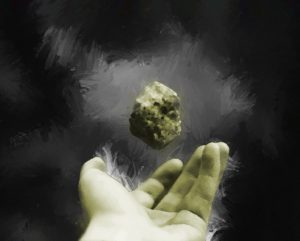
Oh well, at least we tried, I thought as I tossed the stone a few feet away. That’s when it happened. As the stone hit the ground, it landed on a rock that was buried just beneath the sand, splitting the wedge perfectly in half.
“Oh my god!” one of my teammates exclaimed, and raced over to grab the smaller stone. “Look at this! It's perfect!”.
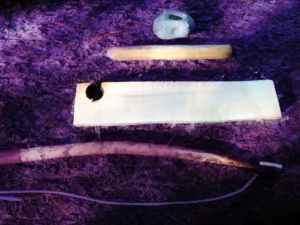 She started carving the notch again. It made the precise wedge cut needed into the center of the fire board. We now had all of the components assembled for the fire kit.
“Who wants to give the bowdrill kit a try?” someone asked. We looked around the circle at each other.
“I’ve been practicing a lot this past year. I can try if no one else wants to,” said one member.
“Yes, go for it!” was the resounding response from the group.
He wrapped the spindle with the cordage, tucked the tinder under the fire board notch, placed the spindle on the fire board, and added the handhold on top. He started bowing quickly.
“Wait,” someone in our group said. “Remember to ask.”
We all paused in silence, and again felt our collective gratitude for fire.
“Two minutes left!!!!”
Our team member began pushing and pulling the bow back and forth. Smoke erupted from the base of the spindle. As a gray cloud rose from our fire board, something strange happened. I noticed a sound behind me. A quiet began to envelop our surroundings. I heard the soft patter of approaching feet all around us. Other groups, realizing that they were not going to succeed in getting fire, slowly put down their kits when they smelled our smoke. They followed their noses toward our group. When I looked up from the smoke of our fire board, a hundred people surrounded our team as we crouched around our fire-maker.
“One minute!!!”
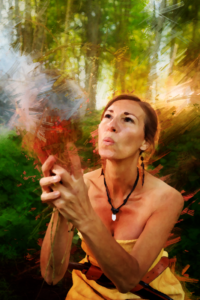 Our fire-maker stopped bowing. There was a collective gasp from the crowd when they saw a small red coal in the notch of the fire board.
He carefully removed the fire board, picked up tinder bundle, and began to blow.
“Thirty seconds!!”
He held the tinder bundle slightly skyward so that the gentle breeze blowing through the forest could help coax the coal to flame. He continued blowing.
“Ten, nine,...”
I’ll never forget the next moment. As the tinder bundle burst into flame, all one hundred plus participants and instructors burst into a triumphant cheer. People all around were jumping up and down, high-fiving, shouting “Yes! Yes! Yes!!” Some of our group members were crying. The beauty of the collective celebration of that moment is something I will never forget. I felt I had been transported thousands of years back, to when someone in my ancestry made fire for the group in a moment of need. It wasn't a celebration for a team's victory, but a celebration of nature providing fire, as it has gifted us for so long.
If you'd like to learn how to make a bow drill fire kit, check out the tutorial video below. One of the most valuable things I have learned from making many bowdrill fire kits over the years is the connection they create to the landscape around me. It's a great opportunity to explore the forests, to learn the trees, grasses, stones, birds, and much, much more. If you have kids, making a bow drill fire with them is nothing short of magical. And, when you feel ready for a ninja challenge, get your stopwatch out, put away your knives, grab some friends, and set the timer to one hour. Oh...and don't forget to ask.

 So when you are looking out the spaceship window, less than .025% of what's down there can make it into your astronaut aqua-pack that is attached to the straw in your space helmet. Back on Earth, if you are lost in the wilderness, the deck is already stacked against you.
 There's a couple ways to look at scenarios that could suddenly cut off our access to water. Survival skills courses often have one consider a situation of being "lost" in the wilderness, and needing to find fresh water to drink. While this happens to a relatively small handful of individuals annually, a more common experience that impacts many people, is that of a natural disaster suddenly shutting off the supply of fresh water. These types of disruptions are happening more frequently, and the topic of something we discussed in a
  As I reached the bottom of this skylight, I found an entrance to the lava tube on either end of the large hole. The surprise that you often find just inside these entrances, are very unique bones. Before humans arrived on the islands, Hawaii was home to an array of flightless birds. Some, like rails, were relatively small, while others, such as a giant flightless duck, were over four feet tall. For some of these birds, they unfortunately would fall down into these large holes. Without the ability to fly out, they eventually died. Inside the entrances on either end I found piles of such bones. Some of these bones could be thousands of years old. Having spied some, I called for reinforcement.
 "Those are probably old carbon fragments from an ancient Hawaiian torch. Someone was probably living in this lava tube. They were likely collecting water from the roots coming out of the ceiling up there. They would put gourds below the roots to catch water," one of them said, pointing to the ceiling of the lava tube where the roots of ohia and koa trees dangled down. Small drips of water were slowly dripping off the ends of the roots. I held my hand out and caught one on the tips of my fingers.
 It involves a paper cup, or an empty glass bottle. Unfortunately (fortunately) there are plenty out there to be found in nature. I remember being mesmerized as a youth on a scout camping trip when first shown this technique. Still am. You can place a paper cup full of water on a bed of coals in a fire. The cup won't burn, and eventually the water will boil. Technically speaking, water needs to reach 158° F (70°C) for one minute to kill 99.999% of bacteria, protozoa, and viruses. Since water boils* at 212°F (100°C), this means that by the time water has reached the boiling point, it is safe to drink.
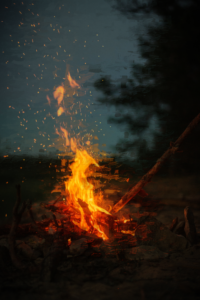 Below is a short video showing one way to boil water with a paper cup on hot coals. You can do this also in a glass bottle, but here's a couple tips I learned the hard way...