
 Sheila Haddad's bio on her website sums up her experience up concisely.
"Her passion is learning."
In her pursuit of learning, Sheila has emerged as a leading inspiration in the fields of martial arts, healing, women's self defense, and photography.
Sheila is a global keynote instructor who has been has been teaching martial arts internationally since 1989. She holds a 15th degree black belt in Bujinkan Budo Taijutsu/Ninjutsu, and was awarded the title of Dai-shihan by Grandmaster Masaaki Hatsumi. She has a 7th degree black belt in Seibukan Jujutsu with the title of Shihan, and a 2nd degree black belt in Hakko Ryu Jujutsu. She also has a 5th degree black belt in Enshin Itto Ryu Batto Jutsu and a 6th degree black belt in Mugai Ryu, under the umbrella name of Enbukan.
Sheila also teaches Self Defense workshops of all levels for girls, teenagers and adult women around the globe. In addition to the physical, Sheila focuses on the psychological aspects of trauma and abuse, broadening awareness, developing intuition and sensitivities for prevention purposes. Sheila is a past Chair and Executive Board Member of American Women’s Self Defense Association and a member of the National Women’s Martial Art Federation. She is also an active member, teacher and past event organizer for the Pacific Association of Women Martial Artists.
 Sheila founded the Seido Institute, an organization devoted to the integration of the warrior and healing arts. The Institute offers international workshops, seminars and certifications in martial arts and Seido Bio-Energy Therapy. She has earned a Masters degree in Psychology.
Her passion for photography has led her from a hobbyist to a semi-professional award winning photographer. She recently printed a photo biography book of Ninjutsu Grandmaster Hatsumi, which can be found in her Webshop.
Through the lens of Sheila's photography, you get a view of this amazing woman, her experiences, her connection to nature, her sense for capturing beauty, and the influence she has created around the globe. It's easy to become lost in her gallery of photos on her website. We chose some highlight photos of hers to share for this interview.
We had an opportunity to ask Sheila about some of her lifelong pursuits and how they intersect.
Pathways: What is your favorite thing about ninjutsu?
 Sheila: There are many aspects of Bujinkan that I love. First, I have trained in other arts, and what sets them apart for me from Bujinkan and Soke’s way of teaching, is the freedom of expression. Of course, in the beginning as with all things, it’s necessary to learn the foundation, the basics and to copy. But once the foundation is laid, it is fun to create, to put pieces together, create something new. It is satisfying for the creative side of myself, I never feel stale, bored, nothing gets old. Second, being honest with what works and what doesn’t, and knowing that sometimes it does in one situation, but not another. There is, as Soke says, no right or wrong way, it works or doesn’t. Training with many different people, in different situations allows me to discover what works when. There is freedom in all this. There is no place to get to, no end of this journey, unless you quit. The longer I am at it, the deeper the rabbit hole. The simplistic intricacies, the obvious subtleties, these continue to amaze and lure me on. Nothing is what it looks, it is the Wonderland of Bujinkan.
Pathways: How has your Seido Bio-energy Therapy influenced your martial arts?
 Sheila: I started Seido Bio-Energy before the martial arts training. The influence has been profound. I think I started from a backwards place. I felt connections, and energetic influences before I knew martial techniques. For a while in my training, I had to consciously put that away so I could learn moves. I felt lacking, empty, but continued until the awkwardness of technique became smooth and fluid, and then I could add my connections and energy and subtle skills to it. I felt whole again, and also much more effective. I learned the outside and already had the inside. Combining them has been powerful and created an effortlessness I love.
Pathways: Has your photography helped you to be a better martial artist? Has your martial arts practice helped you to be a better photographer?
Sheila: Photography and martial art practice are definitely a two-way street. Being at a more skilled level in martial arts before taking my camera to capture Soke helped a lot to know what to focus the lens on. At the same time, honing the lens in on small movements and almost invisible touches by Soke helped my training, as I saw with greater clarity what he was doing. He told me once, after seeing all the images over the years, he said he knows I “feel” through the lens and connect with him as he moves. And that is true, I did feel that.
Pathways: What have you learned about the art of ninjutsu from your photography work with Soke?
 Sheila: All I can add to this question is that being a ninja has helped me in photography in general. When I want to take candid shots, I can make myself be there, but invisible. To not be obtrusive, and in nature, to keep my energy low, to blend in to not disturb, so in this way, training has helped my photography.
Pathways: As a pioneer in martial arts you have created empowerment opportunities for women through martial arts around the globe. What do you think still needs to be done in this area?
Sheila: In terms of women in martial arts, or Bujinkan specifically, we have come a very long way. There are more women training than ever before. Additionally, we can say too, that is related, in my opinion, to our societal changes. I have researched for a joint project that hopefully will come out later this year, and as part of that research, have found four waves of feminism. I won’t go into any of that, but we are entering this 4th wave, globally, and it is reflected in martial arts in general, Bujinkan included. I believe the various kunoichi Taikai we have had the last decade has helped immensely in bringing to light the skills of women, and encouraging more women to join dojos and train. I also think this momentum is continuing on its own, and the younger generation of women and girls don’t have as much of an uphill battle as we did early on. I think going forward, it’s a new situation with Soke no longer teaching, and having individual Soke for each Ryu. All I can say is to keep going, and most emphatically, to keep Soke’s legacy, his teachings, his ways alive.
 Pathways: You have taken your art of photography underwater into nature and in the studio. Has this experience with the element of water influenced your Seido Bio-energy or martial arts practices?
Sheila: All the various aspects of my life are connected, yet on the outside they can seem very different. When I talk to photographers, and they find out the other things I do, it doesn’t really compute, and same with being in the health and healing field, martial arts seem so unrelated. But they are all connected, the deeper principals apply to them all, and yet, the outside is varied so much, that I have variety and fun in doing something different all the time. A new expression of self, over and over, yet a self that is the same.
Pathways: Anything else you'd like to share with us?
Sheila: The most important thing I would like to say in general, is not to get caught up in our own self-importance or identify with what we do. We are not what we do, but let what we do, be an expression of who we are. Be true to yourself, be honest with your short comings, seek to find your blind spots, and express yourself as love and joy in the world. We certainly need more of that. And of course, keep training, because within that you discover so much more. And if you are the type that loves to learn, to discover and be an adventurer, then absolutely keep going! Thank you for this opportunity.
 If you would like to learn more and connect to Sheila's body of work, check out the links below.
**********
 Because we like to share training videos as part of this blog, we decided to take a look at one of the most popular videos of Sheila on the internet. This video is from her Seibukan Jujutsu 7th degree black belt test. Trust me, this is one of those videos that you will want to play on Youtube at slow speed to truly digest all of the techniques she does for this test. As you can imagine, it's not really a spoiler to say she passed this test.
But being the ninjas that we are, we wanted to take you on a deeper dive (roll) into one of the techniques she demonstrates in the above video. In the video below, Sensei Roemke breaks down one of these advanced techniques and shows multiple variations.
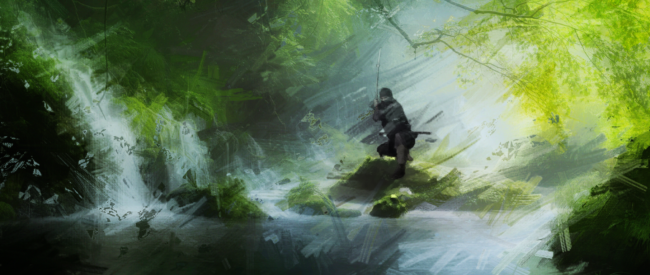
 In the early 1980's, a national health crisis emerged in Japan that resulted from increasing industrialization and a culture of overwork. During this time, researchers in Japan discovered that trees released certain chemicals to protect themselves and the forest around them from diseases and pests. They discovered when humans were exposed to these chemicals known as phytoncides, they too demonstrated increased health and vigor as evidenced by elevated moods, lowered stress hormones, increased immune responses and more. Government officials in Japan encouraged people to practice “Shinrin-yoku” which translates to “bathe in the forest atmosphere” and thus “Forest Bathing” was born.
 Pathways: For people not familiar with Forest Therapy or the Japanese practice of Shinrin-yoku, could you describe this practice?
 Caitlin: There are so many benefits to forest bathing and simply spending time in nature. There is a growing body of scientific research that confirms what seems like an obvious truth— human beings benefit from engaging with the natural world. The list of well documented benefits of forest bathing is quite extensive. Benefits include lowered cortisol and stress hormones, reduced inflammation, elevated mood, lowered blood pressure, increased focus and attention, and enhanced creativity. There are many more documented benefits. One of the most exciting discoveries, which sparked the movement of Forest Bathing, is the discovery that chemicals released by trees to protect themselves and their forest communities from pests and diseases also dramatically enhance immunity in human beings. When we spend time in nature, and specifically amongst trees, we are exposed to these chemicals and it causes our immune systems to produce a special white blood cell called a "natural killer cell". It's a scary little name for a highly beneficial cell that has the ability to find and combat disease in a cell before the cell has any signs of damage. In a sense, the forest has the potential to heal us before we are even sick.
 There are two outcomes that are most universal and profound for people. One is the increased understanding of how to create a non-coercive experience for others. Learning to do this is a big part of the training and it is also profound because it is something that is rarely modeled or experienced in the western world. The other outcome that is closely tied with this is an increased faith in nature to give people exactly what they need, when they need it.
 Caitlin: I think one of the coveted gifts of this martial art is the ability to blend in and to be invisible. Besides the obvious health benefits that I already mentioned, I think this practice may be of particular interest to a ninjutsu practitioner for one simple and esoteric reason—you do not become invisible by hiding in the forest. You become invisible by being hidden by the forest. It takes attunement and relationship-building with nature to understand how to let the land fold you into itself. Attunement with nature is at the heart of the forest therapy guide training.
 There is a little book I love called "What a Plant Knows" by Daniel Chamovitz. It's all about the sensory experience of plants that science has confirmed thus far. The first sentence of the book says "Think about this: plants see you." I think it is important to take this type of understanding with us into our forest bathing experiences because not only does it increase the benefits that we as humans get from the experience, but it also increases the likelihood that we will develop a sense of stewardship and reciprocity with the natural world. It matters that we understand we are not alone in this world, for our own health, and for the health of this world we co-occupy with other life.